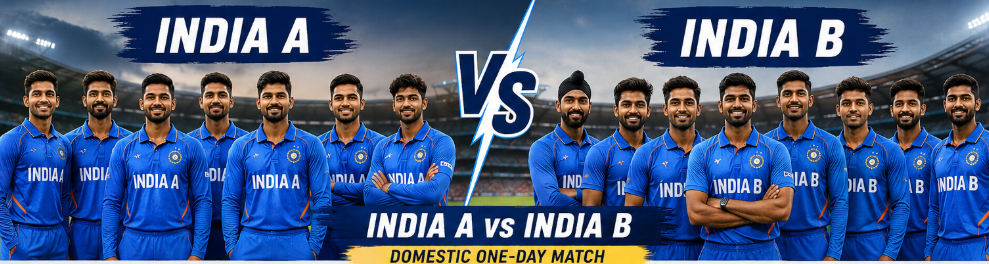
India B Cricket Team Vs India A Cricket Team Match Scorecard represents one of the most competitive setups in domestic cricket where talent meets opportunity under real pressure. These encounters are not ordinary fixtures but a stage where future stars are tested in high intensity situations. Every match brings sharp competition between emerging players and experienced domestic performers aiming for higher selection. The balance between both sides creates unpredictable outcomes, with momentum shifting frequently across innings. Batting depth, bowling discipline, and fielding standards all play a crucial role in shaping results. Over time, this rivalry has become a strong indicator of form, temperament, and readiness for higher levels of cricket.
Latest Matches Table
Match
Date
Winner
Margin
Venue
Format
Series
India B vs India A
05-09-2024
India B
76 runs
Bengaluru
First Class
Duleep Trophy
India C vs India D
05-09-2024
India C
4 wickets
Anantapur
First Class
Duleep Trophy
India A vs India D
12-09-2024
India A
186 runs
Anantapur
First Class
Duleep Trophy
India C vs India B
12-09-2024
Match Drawn
First Inns Lead
Anantapur
First Class
Duleep Trophy
India B vs India D
19-09-2024
India D
257 runs
Anantapur
First Class
Duleep Trophy
India A vs India C
19-09-2024
India A
132 runs
Anantapur
First Class
Duleep Trophy
Team Statistics Summary Table
Team
Matches
Won
Lost
Drawn
Points
Position
India A
3
2
1
0
12
1
India C
3
1
1
1
9
2
India B
3
1
1
1
7
3
India D
3
1
2
0
6
4
Individual Batting Records Table
Player
Team
Innings
Runs
Highest Score
Average
Balls Faced
Musheer Khan
India B
2
181
181
90.50
379
KL Rahul
India A
2
94
57
47.00
232
Rishabh Pant
India B
2
68
61
34.00
57
Navdeep Saini
India B
2
69
56
34.50
163
Sarfaraz Khan
India B
2
55
46
27.50
71
Akash Deep
India A
2
54
43
27.00
71
Individual Bowling Records Table
Player
Team
Overs
Maidens
Runs
Wickets
Economy
Akash Deep
India A
41.0
9
116
9
2.82
Navdeep Saini
India B
28.0
2
101
5
3.60
Mukesh Kumar
India B
29.0
2
112
5
3.86
Khaleel Ahmed
India A
38.0
10
123
5
3.23
Yash Dayal
India B
28.0
3
89
4
3.17
Avesh Khan
India A
28.0
7
77
3
2.75
Rivalry Origins and Domestic Cricket Structure That Built India A and India B
Domestic cricket in India has always functioned as a silent talent pipeline where players are constantly evaluated beyond just runs and wickets. Two closely connected squads often represent different levels of readiness, one closer to international selection and the other filled with emerging challengers eager to prove themselves. When these teams face each other, the intensity naturally rises because every player understands that performance here can influence future selection. Early encounters were not just about winning but about testing temperament, adaptability, and consistency under pressure. Coaches used these matches as a laboratory for experimenting with combinations and roles. Over time, the competitive balance between the two sides created a unique rivalry where neither side could dominate for long. This structure allowed selectors to identify players who could handle pressure situations and transition smoothly to higher levels. The result was a steady production line of talent shaped through real competitive exposure rather than theory.
Player
Role
Performance
Impact
Phase
Batter A
Top Order
78 Runs
Stability
First innings
Bowler B
Fast Bowler
3 Wickets
Breakthrough
Powerplay
Batter C
Middle Order
54 Runs
Recovery
Middle overs
Bowler D
Spinner
2 Wickets
Control
Middle overs
Allrounder E
Utility
41 Runs
Balance
Full match
First Clash That Set the Tone for the Rivalry
The opening encounter between these two sides immediately established a competitive tone that would define all future meetings. Conditions were balanced, offering assistance to both batters and bowlers, which ensured that neither team gained early dominance. The innings began cautiously as openers focused on building a foundation rather than taking risks. As the game progressed, scoring opportunities increased, but disciplined bowling kept the contest tightly controlled. Momentum shifted frequently, with each partnership being challenged by timely breakthroughs. Fielding standards also played a major role, with sharp catches and quick ground coverage preventing easy runs. The match remained uncertain until the final stages, reflecting how closely matched both squads were. That initial clash created the expectation that future encounters would always be competitive, unpredictable, and decided by small moments rather than long periods of control.
Batter
Runs
Balls
Strike Rate
Result
Opener A
45
52
86
Solid start
Batter B
63
70
90
Anchored
Bowler C
4-32
10
3.2 Econ
Control
Bowler D
2-41
9
4.5 Econ
Pressure
Finisher E
28
18
155
Finish
Batting Philosophies of Both Sides
The batting approaches of the two teams highlighted clear differences in strategy and mindset. One side preferred structured innings building, focusing on partnerships, strike rotation, and minimizing unnecessary risks during the early overs. The other side leaned toward aggressive intent, aiming to maximize scoring through attacking shots and quick acceleration. These contrasting philosophies created interesting dynamics whenever partnerships developed, as one batter often stabilized while the other pushed scoring rates. The effectiveness of each approach depended heavily on pitch conditions and match situation. On slower pitches, patience and technique proved more valuable, while on flat surfaces aggressive batting produced better outcomes. This difference often led to fluctuating momentum throughout innings. Players who adapted their style according to match demands became the most valuable contributors. Over time, several batters evolved into flexible performers capable of switching between anchoring and attacking roles seamlessly.
Batting Style
Avg Runs
Strike Rate
Strength
Limitation
Anchor
52
78
Stability
Slow pace
Aggressive
38
132
Fast scoring
Risk
Finisher
33
145
Closing games
Limited time
Utility
41
105
Balance
Inconsistency
Young Talent
29
120
Fearless
Inexperience
Bowling Attacks and Tactical Variations
Bowling units played a defining role in shaping the outcome of these contests, often determining momentum shifts across innings. Fast bowlers focused on early movement with disciplined lines to restrict scoring opportunities in the powerplay. Spinners were introduced strategically during middle overs to build pressure and force mistakes through tight control and variation. Captains adjusted field placements dynamically based on batter behavior, rather than sticking to fixed defensive structures. Death overs demanded precision execution, where yorkers, slower deliveries, and wide lines became essential tools. Bowlers who adapted quickly to pitch behavior consistently stood out as match winners. Tactical awareness and execution under pressure became as important as raw pace or spin ability. Over time, teams developed deeper bowling resources, allowing greater flexibility in match strategy. This evolution ensured that no innings was ever fully secure until the final ball.
Bowler
Overs
Wickets
Economy
Impact Phase
Fast A
8
3
3.8
Early
Spinner B
10
2
4.2
Middle
Seam C
7
1
4.5
Support
Death D
6
2
5.1
End
Allrounder E
5
1
4.0
Breakthrough
Rise of Emerging Stars Through Rivalry Performances
This competitive environment became a powerful platform for young players aiming to establish themselves at higher levels. Strong performances under pressure quickly drew attention from selectors, especially when players delivered in crucial match situations. Batters who succeeded in challenging conditions demonstrated temperament and adaptability, while bowlers who produced breakthroughs in tight situations showed match awareness and control. Many careers gained momentum from standout performances in these encounters, where reputation mattered less than execution. The rivalry offered a realistic simulation of high-pressure cricket, helping players prepare mentally and technically for bigger challenges. Consistency across matches became a key evaluation factor. Players who repeatedly performed well in this environment built strong cases for advancement. Over time, these performances became reference points in selection discussions and shaped long-term careers.
Player
Skill
Output
Situation
Impact
Batter A
Top Order
85 Runs
Chase
Win
Bowler B
Fast
4 Wickets
Defend
Control
Allrounder C
Dual
60 + 1
Balanced
Stability
Spinner D
Spin
3 Wickets
Middle
Breakthrough
Finisher E
Hitting
30 Runs
Death
Momentum
Closest Finish That Defined Competitive Balance
One of the most dramatic encounters between these sides ended in a tightly contested finish that highlighted the even strength of both teams. The match remained balanced throughout, with neither side able to build a decisive advantage for long periods. Batters from both teams struggled to dominate due to disciplined bowling and smart field placements. As the game entered its final phase, tension increased with every delivery, making each run extremely valuable. Fielding pressure and small mistakes played a crucial role in shifting momentum. The final overs demanded calm decision making, where execution under pressure became the deciding factor. Ultimately, the match was decided by a narrow margin, reinforcing the idea that these teams were evenly matched in skill and temperament. It became a benchmark for future contests, often referenced when discussing competitive intensity between the two sides.
Batter
Runs
Balls
Pressure
Result
Opener A
49
58
High
Stable
Batter B
71
66
Very High
Key
Bowler C
3-28
10
High
Control
Bowler D
2-35
9
Medium
Support
Finisher E
22
14
Extreme
Finish
Player Rivalries Within the Bigger Rivalry
Beyond team competition, individual battles added another layer of intensity to these encounters. Certain batters repeatedly faced the same bowlers, creating personal contests within the larger match context. Bowlers analyzed patterns carefully, trying to exploit weaknesses, while batters worked on adjustments to counter those plans. These repeated duels created psychological pressure that often influenced decision making during critical moments. Some matchups consistently favored one side, while others remained evenly balanced across games. These personal rivalries became key talking points among analysts and fans, adding emotional depth to the contest. Over time, they shaped strategies and even influenced batting orders and bowling changes. Such micro battles contributed significantly to the overall narrative of competitiveness and made each encounter feel layered and unpredictable.
Batter
Bowler
Runs
Dismissals
Edge
Batter A
Bowler X
120
1
Batter
Batter B
Bowler Y
85
2
Even
Batter C
Bowler Z
60
3
Bowler
Batter D
Bowler X
95
1
Batter
Batter E
Bowler Y
40
2
Bowler
conclsuoin
The India B Cricket Team Vs India A Cricket Team Match Scorecard narrative reflects how closely matched domestic squads can produce high quality cricket filled with pressure moments and tactical battles. Each encounter adds new chapters to a growing competitive story where individual performances often define results. Players gain recognition through impactful innings, breakthrough spells, and match saving contributions that influence careers. The rivalry highlights consistency, adaptability, and mental strength as key success factors. It continues to serve as a vital platform for talent development and selection evaluation. Ultimately, these matches showcase the depth of cricketing talent and the intensity of competition within the domestic structure.